An Initial Look at Management of Mainland Churches
The Lack of Church Management
Churches are believers' homes on earth, and believers God-appointed stewards of them. But in China today, churches generally lack management, neither do the believers understand the importance of management to church development. In one extreme, some believers putting much weight on sermons and pastoral work regard church management as dispensable "secular" work. In fact, good church management is an important form of service for God. It is becoming more and more important with the continual increase in the number of believers.
Types of Management
The models of and expectations for management differ among urban, rural, big and small churches. Generally speaking, various aspects are involved: financial (managing church's income and expenditure), ministry-related (training of co-workers and volunteers; evangelical and nurturing work etc), teaching-related (setting up Sunday school, worship services, the Holy communion and so forth) and other matters (such as church maintenance and expansion).
The Lack of Management/"Paternal" Management Style
Undoubtedly, Chinese churches have been subject to the will of people, and lack an effective management system. This easily causes a formal regulatory system to give way to personal manipulations. For some churches, it is not that they have not got a management system but due to a lack of knowledge or respect for it, there are problems implementing the system since some believers consider management to be a worldly thing.
Currently, quite a number of mainland churches are run under a "paternal model", that is having a leader in control of all church affairs, or appoint someone to be in charge. Actually, some church leaders have been regarded as abusing their power for personal gains, or taking to the podium to launch attacks against others. This has caused harm to believers and could lead a church to the path of destruction.
Financial Management
Sound financial management is an important factor behind proper management. Often church disputes occur over money. Church and pastoral staff should not be directly involved in financial management, but rather hand over the task to lay leaders. There is also a need for an effective monitoring system and increased transparency. A clear division of work is necessary. On the other hand, churches should lay down principles for spending money and make them known to workers and believers. For example, an elderly pastor at a rural church has kept his church's only savings of 3,000RMB in a bank and did not use it to pay for any travel expenses of co-workers preaching at other churches. This has caused a split within the church and affected its development. Examples like this show the importance of setting out the principles for spending money so as to minimize staff conflicts.
Management of Ministry and Teaching-related Work
Apart from financial management, it is also crucial for churches to manage their ministry and teaching-related work. An urban church in the province of Zhejiang has formed sizeable volunteer teams, with members responsible for various tasks, including preaching, serving (home-visiting and choir), and managing (doing administrative duties). They are given specialized training and serve according to their own gifts. There are also other types of training such as the urban area-based volunteer training for university students, rural area-based volunteer training for people living in villages, to provide servants for the Lord within and outside the city. The church has also divided its numerous members into small groups. To help the group leaders grow spiritually and become able to nurture their own members, 10 care groups have been formed for them, involving sharings and Bible reading. This effective management helps the growth of the church.
Other Church Matters
Since mainland pastors are often the ones in charge of church affairs, they have to deal with many matters outside of preaching and nurturing, such as church renovation work. They are made extremely busy by an imbalanced division of labour.
Management of Rural Churches
Rural churches are plentiful in number but relatively limited in resources. Their co-workers also have little understanding about management. Hence it is difficult for them to set up a proper management system. It is especially the case with non-open churches, where power is concentrated in the hands of one pastor/co-worker/volunteer. The lack of transparency over financial management and the infiltration of the cults can pose obstacles to the churches' development. Basic management principles should be laid down to minimize the chances of power struggles and financial chaos.
Thanksgiving and Prayer Items:
- Pray that mainland churches will pay attention to management, that the Lord can let their leaders understand the importance of management to church development and not be hindered by worries.
- May the Lord let church leaders, co-workers and believers adopt a management system that can benefit people and bring glory to God.
- May the Lord change the negative phenomenon in churches: abuse of power by leaders, financial chaos, power struggle, and the spread of the cults. Pray that the Lord correct the situation and help churches walk in His will.
- May the Lord bless churches that operate on the basis of His teachings, so that they can bear witness to Him in their work.
- May the Lord show mercy to rural churches, bless their leaders so they can be loyal to Him and set up an effective system for managing finances and warding against cults.
Another Prayer Request
The Church that Survived a Catastrophe
"Our church has more than 20 people about a year ago. But due to the infiltration of the Eastern Lightning, half of our believers had left, leaving 11 people behind. Later a brother sent us some religious leaflets and Bible commentaries. Now, our church congregation grew to more than 70 people. Thirty-eight participated in our last baptism, which was recently held for the first time. Half of our church members were willing to be baptised. Several untrained teachers are now taking turn to teach our congregation the Bible, though only two are teaching on a regular basis. Using a daily devotion book, they guide believers through a scripture each day, in order to help them learn about Biblical truths." (Sharing by a mainland believer who has been requesting Christian books)
We should give thanks to God for the church that survived the catastrophe. May God continue to help them win more souls. Also may God prepare training opportunities for their untrained Bible teachers so they can help more believers know His Word. The training of Bible teachers is an important task in the mainland. How can believers be nurtured if the teachers themselves are not equipped? Please remember the training work and pray that there will be a breakthrough.
 Secret Seminary
 For six months of the year, these students live in the cave, leaving infrequently and only under the protective cover of darkness. Their day starts at 6 a.m., with prayer and devotion. Around 8 a.m. the students receive their first meal of the day, which is a bun with mincemeat. They usually don’t eat again until dinner, which features the same “meal” as breakfast. Their intense education takes place between these two small meals. After a rigorous day of learning, they fall asleep on a bed of hay on the cave floor.
 Being a Christian in China effectively involves making a political choice: deciding whether to worship at a government-approved church, or at an unofficial gathering known as a “house church.”
 On Sunday mornings in Beijing, worship songs can be heard coming from a high-rise apartment complex. Each week, more than 50 people quietly file up three flights of stairs into a small, two-bedroom apartment. Members are reminded to keep quiet in the hallways, so as not to bother the neighbors. Once inside, however, subdued demeanors transform into a room full of smiling faces. Every seat in the room is filled with students and young adults. Latecomers sit in hallways and bedrooms, where they have to strain to hear the message. The service includes Chinese worship songs, mixed with an occasional familiar Western hymn or praise chorus. The speaker comes from a rotating roster of local pastors, evangelists and lay leaders who circuit through a network of a dozen congregations throughout the city.
 In China, any unauthorized religious meeting is deemed a criminal offense and anyone involved can be prosecuted. This forces many Christians underground.
 And while we can attest that the Christian movement is sweeping the country, no one knows for sure how many Christians there are in the still officially atheist state. Some estimate China’s total Christian population to be from 75 to 130 million. While approximately 20 million are in the officially registered Three-Self government churches, the remaining majority of Chinese Christians worship in unregistered house churches.
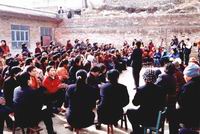 A pastor in Eastern China told us that last year they were invited by a church in another province to organize a summer camp for more than 600 children, many of whom began attending the church after the camp. The need for children Sunday school arose but no one in the church knew how to do it! As a result, the pastor was asked to provide a 10-day training to train up Sunday school teachers for them. The first two days of training was for church leaders, followed by eight days of training for Sunday school teachers. The pastor knew very well that the Sunday school ministry would be stagnant even if there were teachers available if the church leaders had no vision for it.
 The training of church workers, including Sunday school teachers, Bible teachers, Bible study group leaders or volunteer workers is an important ministry in the mainland. Training classes and centres have been organized in various areas by various churches. Of course, it is important to train up Sunday school teachers, but key to the ministry is the church leaders behind. The wife of another pastor in Eastern China told us that churches used to think that children Sunday school could be handled by a few sisters. Yet she and her husband saw that children today was the hope of the next generation of churches in China. They went all over the province to promote children Sunday school in various churches, trying to change leaders' conceptions, encourage and help them build up the ministry. This resulted in a sea change in attitudes and the setting up of systematic ministries.
 There are more than 20 million university students across the nation (about 1.5 per cent of the total population), and their number is on the rise. They will be playing an important role in the society. Yet they are under the onslaught of various forces, such as materialism, declining moral standards and so forth. Temptations are everywhere. In February this year, the Beijing Youth Daily listed the issues university students faced during their four years of studies (according to an analysis by psychologists at the Beijing Tongren Hospital): the first year is most problematic, due to the need for various adjustments; academic problems are common in the second year; problems related to love affairs are more often found in the third year; the problem in the fourth year relates to "the future". During the four-year period, university students are under all sorts of pressure. Do they have a way out? How about their religious choices? What about Christian students? The following is the sharing by a university student in western China:
 Many were exposed to religions when they were small, under the influence of their grandparents. Some had even followed adults to burn incense in temples, and therefore considered themselves to be Buddhists though they did not abide by the teachings of Buddhism. On the other hand, the young generation have not had much chance to know much about Taoism, which is more "hidden from the social scene".